You probably have data flowing from several systems in your business. Customer information could be stored in a CRM, sales information in a database, events on a website, and financial data in an ERP system. The hard part isn’t getting this data; it’s getting it all together, cleaning it, AND making it actionable.
This is where an ETL pipeline can help.
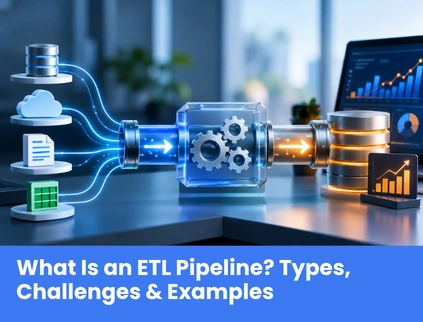
ETL stands for Extract, Transform, and Load. An ETL pipeline includes the process of moving data from different items, preparing the data for analysis and loading the data into a target system, such as a data warehouse, database, or analytics platform.
The only time that I find ETL really useful is when my business is dealing with data from various systems. For small collections of data, it may be possible to use manual data movement, but as the size of the data and the count of data sources increases, managing the data movement becomes challenging.
What is an ETL Pipeline?
ETL stands for Extract, Transform, Load and is a collection of automated steps that execute from the source systems to the destination and extract, transform and load the data in a usable format.
You could have inventory stored in a different database, orders in an e-commerce solution, and customer details in Salesforce, for example. The three systems can be combined by an ETL pipeline to a centralized environment.
The process of ETL has three steps:
- Extract: Collecting information from a variety of sources.
- Transform: Clean, validate, standardize & restructure data.
- Load: Transfer of the ready-to-go data to the target system.
After data is made available in the target environment, it can be used for reporting, business intelligence, analytics, forecasting and machine learning.
How Does an ETL Pipeline Work?
1. Extracting Data
The first step is to get the data from your source system. These can come from:
- Databases
- CRM and ERP systems
- APIs
- Cloud applications
- CSV and JSON files
- Websites and applications
- IoT devices
Your pipeline has the ability to pull out the info you need, and also preserve information you will need for future procedures.
2. Transform Data
Raw data is usually not available to be analysed in a ready form. Records may be duplicated, missing, use inconsistent names, or have different date formats. Your ETL processes can do the following things when you are transforming the data:
- Removing duplicate records
- Handling missing values
- Standardizing formats
- Validating records
- A combination of data from various sources
- Eliminating noise
- Applying business rules
- Aggregating data
You can, for instance, normalize a date from 09/28/2026 to 2026-09-28 for two different systems.
Often, resizing those minor inconsistencies to great things occurs when merging data from various systems. This is because by eliminating incorrect data from your list before you analyze it, you reduce the chance of the data being misrepresented in other reports.
3. Load Data
Once transformed, the data is loaded into the target system. Common destinations include:
- Data warehouse
- Data lake
- Database
- Cloud storage
- Business intelligence platforms
In modern data environments, these platforms could be part of the architecture, including Snowflake, Databricks, Amazon Redshift, or Google BigQuery.
Types of ETL Pipelines
Your ETL architecture should match the increasing volume of data and business requirements. Common types include:
Batch ETL
A batch ETL pipeline runs at a regular time. An example of this would be running a pipeline every night to move the daily sales into a data warehouse. When you don’t need the information to be current as decisions are made, batch ETL is a good choice.
Real-time ETL
A real-time ETL pipeline works with the data as it is generated or very recently. This can be used when you need to:
- Fraud detection
- Financial transactions
- IoT monitoring
- Customer activity
- Operational alerts
Speed is not the only factor when working with real-time data. Stability in monitoring, error processing and an infrastructure capable of handling a steady stream of data flow are also necessities.
Incremental ETL
An incremental ETL pipeline only fetches new or changed data, instead of the entire dataset, on each execution. If you have 20 million customer records and just 50,000 of them have changed in the last time you run the program. Only accepting changes can save computing resources and time.
This is especially useful if using a large dataset.
Cloud ETL
Cloud ETL pipelines utilize cloud infrastructure and services to process and move data. Cloud-based ETL allows to scale processing up as data demands grow. But there are still security, data quality, monitoring and cost issues to consider.
What Are the Challenges of ETL Pipelines?
ETL is capable of automating many aspects, but careful planning is necessary to build a pipeline.
Data Quality
Duplicate, incomplete or incorrect data may affect your reporting and analytics. Data validation and data quality checks are required in your pipeline.
Scalability
If the pipeline is good for a few gigabytes, then it might not be so good for terabytes. Your architecture needs to accommodate more data, while avoiding unnecessarily high processing costs and delays.
Pipeline Failures
APIs may go idle, databases become inaccessible, and data schemas change. So add logging, monitoring, error handling, retries, and alerts to your ETL pipeline.
Changing Data Sources
Sources of data can vary from year to year. Existing workflows can be interfered with by new fields, changing data types, or API changes. These changes can be detected by regular monitoring and schema management to prevent the influence on downstream analytics.
Data Security
Customer, Financial, or other sensitive data is possible in ETL pipelines. There should be the right kind of controls in place for authentication, authorization, encryption and access.
ETL Pipeline Example
Suppose that you have an e-commerce business. Your website records orders, your CRM (Customer Relationship Management) stores customer information, your payment solution tracks payments and your inventory database keeps product information.
These systems can be connected using an ETL pipeline. Extract: Collect customer, order, payment and inventory information.
- Transform: Delete duplicate customer records, normalize product data, validate customer transactions, and compute reports and statistics such as revenue.
- Load: Send the processed data to your data warehouse.
- This data can then be used by your analytics team to gain insights into everything from sales trends to customer behavior to product performance to revenue.
If the data pipeline isn’t automated, analysts may need to do the data consolidation manually, a time-consuming and error-prone process.
ETL vs. ELT: What’s the Difference?
The terms ETL and ELT are often used interchangeably. The significant difference is the time the transformation occurs.
- ETL involves three stages: Extracting data, transforming data, and loading it into the target system.
- ELT means the data is extracted from the source system, and then loaded to the target platform. You then manipulate the data in that platform.
- ELT now becomes very practical thanks to modern cloud data platforms that can power up with vast resources to process large datasets.
- It depends on how you need to store and utilize your data, security limitations, and the platform you’re trying to target.
Why Are ETL Pipelines Important?
If there is any need to consolidate data from multiple sources into a single source, there will be a reliable ETL pipeline to do so. It can help you:
- Minimize manual data preparation
- Improve data consistency
- Automate repetitive workflows
- Support business intelligence
- Enhance reporting
- Process the data to be used in analytics and machine learning.
- Develop a single data domain
The more your business expands, the more you need its value. If several teams are using the same data, it’s hard to move the data back and forth between systems.
Final Thoughts
An ETL pipeline can be used to reliably extract data from multiple sources, transform it to a common format, and load it into a system. You have the option to use batch ETL, real-time ETL, incremental processing, or cloud ETL, and your approach should depend on your business needs.
When your data environment grows, keep an eye on data quality, scalability, security, supervision, and error catching. They will help you decide if your ETL process can continue to be trusted with an increasing amount of business and data. With regard to building a data warehouse, modern data platform, or a large-scale data integration strategy, knowing how ETL pipelines work is a great foundation for making the right architectural decisions.